
Desserts
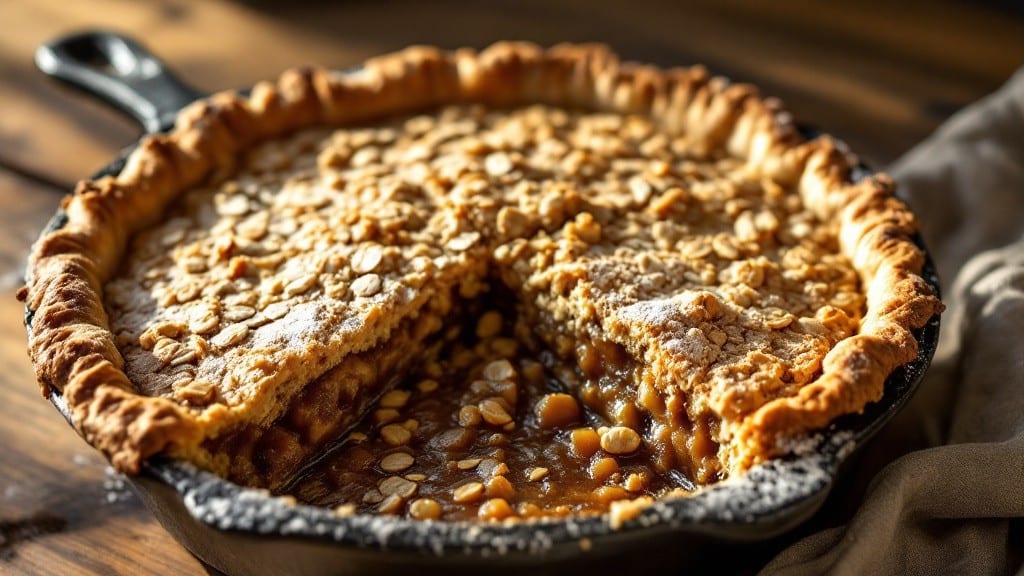
This Amish pie recipe delivers the comforting, molasses-kissed oat crown you’ve been craving—layered over velvety vanilla cream that tastes like a slice of Pennsylvania nostalgia. 🌟 The traditional recipe balances sweetness and texture perfectly, with a filling that’s rich yet not overly indulgent, and a crust that’s sturdy enough to hold its shape through every slice.
I’ve baked this version countless times for family gatherings, and it never fails to disappear faster than the coffee pot gets refilled.
The beauty of this pie lies in its simplicity: a buttery, flaky crust encases a hearty oat and molasses filling, topped with a luscious vanilla custard that’s thick enough to hold its shape but light enough to melt in your mouth.
The molasses brings deep caramel notes that pair beautifully with the warm spices—cinnamon, nutmeg, and allspice—while the oats add a satisfying chewiness that balances the custard’s smoothness. It’s the kind of dessert that feels both rustic and refined, proving that tradition doesn’t mean sacrificing flavor.
What makes this recipe truly special is how it captures the essence of Amish baking—heartfelt, practical, and deeply satisfying. The oat filling bakes to a golden, slightly crispy top, while the custard layer stays silky and rich, creating a contrast that’s impossible to resist.
Baking time is about an hour, but the aroma filling your kitchen halfway through will make it feel like a labor of love worth every minute.
Serve it warm with a scoop of vanilla ice cream, and you’ll understand why this pie has been a staple in Amish households for generations.
This dessert is perfect for holidays, potlucks, or whenever you need a taste of home. The recipe scales easily, so you can adjust the size of your pie pan to fit your needs—just keep the proportions balanced.
Once you try this version, you’ll see why it’s a beloved classic that stands the test of time. Let’s get baking!
Ingredients for amish pie
Buttery crust, molasses-spiced oats, and velvety vanilla custard—this pie needs just 15 simple ingredients for maximum comfort.
| Ingredient | Amount | Notes |
|---|---|---|
| All-Purpose Flour 🌾 | 2 ½ cups | Sifted for flaky crust |
| Unsalted Butter 🧈 | 1 cup | Cold, cubed for crust |
| Granulated Sugar 🍚 | ½ cup | Plus 2 tbsp for topping |
| Light Brown Sugar 🍚 | ½ cup | Packed, for filling |
| Molasses 🍯 | ½ cup | Unsulphured for rich flavor |
| Old-Fashioned Rolled Oats 🍞 | 2 cups | Not quick oats |
| Ground Cinnamon 🌿 | 2 tsp | Freshly ground preferred |
| Ground Nutmeg 🌿 | ½ tsp | Freshly grated nutmeg |
| Ground Allspice 🌶️ | ¼ tsp | For warm spice depth |
| Salt 🧂 | ½ tsp | Fine sea salt |
| Heavy Whipping Cream 🥛 | 2 cups | Full-fat for custard |
| Large Eggs 🥚 | 4 whole | Room temperature |
| Granulated Sugar 🍚 | ¾ cup | For custard layer |
| Pure Vanilla Extract 🍯 | 1 tbsp | High-quality preferred |
| Vanilla Bean Paste 🌿 | ½ tsp | Optional for extra flavor |
The molasses makes or breaks this pie. Grocery store brands work fine, but Blackstrap molasses from the bulk section at Whole Foods or Trader Joe's gives that deep, rich flavor. Look for labels that say 'unsulphured'—it's sweeter and less bitter. I always grab extra because it's so versatile. The oats? Old-fashioned rolled oats are non-negotiable—quick oats turn mushy. Store them in an airtight container to keep them fresh. For the crust, European-style butter like Plugra gives the most flaky layers, but regular unsalted butter works too if that's what you've got.
No molasses? Maple syrup or dark corn syrup can stand in, but reduce the amount by about a third. Running out of vanilla extract? Vanilla bean paste works perfectly—just use half the amount since it's more concentrated. The spices are key here: if you can't find allspice, a pinch of cloves gives a similar warmth. For the custard, heavy whipping cream is a must—light cream won't give that silky texture. Want to make it ahead? The filling can be prepped a day in advance and stored in the fridge, but the custard is best made fresh the day you bake.
This pie tastes even better the next day, so bake it when you can—it reheats beautifully. Store the whole pie in an airtight container at room temperature for up to 3 days, or freeze individual slices for up to 3 months. The crust stays crispy if you wrap it tightly with plastic wrap. For serving, a scoop of vanilla ice cream is traditional, but I love it with a dollop of whipped cream too. The aroma alone will have your kitchen smelling like a Pennsylvania farmhouse by the time it's done.
Why You'll Love This Recipe
- No-Fuss Layers: I swear by this recipe because it’s basically a no-brainer—just mix, pour, bake. The crust comes together with butter and flour in minutes, and the filling? A simple sugar-molasses melt that doesn’t require stirring every five minutes. (Yes, even when I’m distracted.)
- Molasses Magic: That deep, caramelized molasses kick is what makes this pie ridiculously good. It’s not too sweet, not too bitter—just the perfect balance with the brown sugar’s richness. Honestly, I’ll take this over store-bought any day, especially when it’s still warm.
- Weeknight Crowd-Pleaser: This pie is my go-to for potlucks, family dinners, or when I need something foolproof for guests. It’s not fussy enough to stress over, but it’s solid enough that everyone will ask for seconds. (My husband’s a skeptic, but even he won’t turn it down.)
- Budget-Friendly Staples: You’re using pantry basics here—flour, sugar, butter, molasses—and it tastes like a special occasion. I’ve made this for under $5 total, and it feeds six without breaking the bank. Leftovers? They’re even better the next day, sliced thin with a cup of coffee.
Step-by-step instructions for molasses-kissed oat crown over vanilla cream heaven
Here's how to build this Amish classic layer by layer—crispy oat crust meets velvety custard.
👨🍳 Step 1: Prepare the Oat Crust Mixture
In a large bowl, combine the 2.5 cups all-purpose flour, 2 cups old-fashioned rolled oats, 2 tsp ground cinnamon, 0.5 tsp ground nutmeg, 0.25 tsp ground allspice, and 0.5 tsp salt. Whisk until evenly distributed—those oats should be completely coated with flour for a tender crust. Here's the thing—don't pulse them in a food processor or you'll end up with oatmeal instead of a crunchy texture.
Cut in the 1 cup cold unsalted butter using a pastry cutter or your fingers until the mixture resembles coarse crumbs with pea-sized butter pieces remaining. This cold butter creates steam during baking, which gives the crust its signature flakiness. If your butter starts melting too quickly, chill the bowl for 5 minutes before continuing.
🍳 Step 2: Mix the Molasses Filling
In a separate bowl, whisk together the 0.5 cup granulated sugar, 0.5 cup packed light brown sugar, 0.5 cup unsulphured molasses, 2 tbsp granulated sugar (for topping), and 1 tbsp pure vanilla extract. The molasses will be thick—this is normal. If it's too stiff to mix, warm it slightly in the microwave for 10-15 seconds to loosen it up. Stir in the 0.5 tsp vanilla bean paste if using for that extra depth of flavor.
This filling is what makes Amish pie uniquely special. The molasses provides that deep, caramel-like sweetness that balances perfectly with the custard layer. Don't skip measuring the molasses precisely—too much and it'll be overwhelming; too little and you'll miss that classic Amish flavor.
🥘 Step 3: Assemble the Pie Layers
Preheat your oven to 350°F and grease a 9-inch deep-dish pie dish lightly with butter. Press half of the oat crust mixture firmly into the bottom of the pie dish, creating an even layer about ¼-inch thick. Here's where it gets tricky—you want to press it down gently but not pack it too tightly or it'll become dense instead of crispy.
Spread the molasses mixture evenly over the crust, leaving about ½-inch border uncovered. This prevents the crust edges from getting soggy during baking. Sprinkle the remaining 2 tbsp granulated sugar over the top for that signature caramelized crust. Then carefully press the remaining oat crust mixture on top, covering the entire filling but not pressing down too hard—you want to keep some air pockets for that crunchy texture.
🔥 Step 4: Bake the Crust to Golden Perfection
Bake the pie for 45-50 minutes until the crust is deep golden brown and the edges are crispy. You'll know it's ready when you can hear that satisfying crackling sound from the oat crust. If the top isn't browning enough, tent it with foil for the last 10 minutes to prevent over-browning while it continues cooking.
Don't open the oven door during baking—each time you peek, you risk letting heat escape and causing the crust to soften. The pie is done when a toothpick inserted near the center comes out clean. Let it cool completely on a wire rack for at least 1 hour before adding the custard layer. This resting time is crucial—it allows the molasses filling to set properly so it doesn't turn into a runny mess when you cut into it.
🍳 Step 5: Prepare the Vanilla Cream Layer
While the pie cools, prepare the custard layer by whisking together the 2 cups heavy whipping cream, 4 whole large eggs, 0.75 cup granulated sugar, 1 tbsp pure vanilla extract, and 0.5 tsp vanilla bean paste in a medium bowl. The mixture should be smooth but slightly thick—almost like a custard. If you prefer a lighter texture, you can strain it through a fine-mesh sieve to remove any potential lumps.
Pour this custard mixture evenly over the cooled pie, spreading it to the edges. Here's the moment that matters: place the pie on a baking sheet (to catch any potential drips) and bake at 325°F for 30-35 minutes until the custard is set but still slightly jiggly in the center. The edges should be golden brown but the center should still have a slight wobble—it'll continue setting as it cools.
⏰ Step 6: Chill and Serve
Remove the pie from the oven and let it cool completely at room temperature for 30 minutes. Then refrigerate for at least 4 hours or overnight. This chilling time is what transforms the pie into its final glorious form—the custard will firm up beautifully while the oat crust maintains its perfect crunch.
When ready to serve, run a thin knife around the edges to loosen it from the pie dish. Slide it onto a serving plate and slice into wedges. Each bite should deliver that perfect combination of crispy oat crust, caramelized molasses filling, and silky vanilla cream. Serve with a dollop of whipped cream if you're feeling extra indulgent!
Pro Tips For Making Amish Pie
- MEASURE MOLASSES PRECISELY: Use a kitchen scale for the molasses—it’s thicker than syrup and varies wildly by brand. I learned this the hard way when my pie turned bitter; 120 grams is your sweet spot for that perfect balance of rich depth without overpowering.
- CUT COLD BUTTER IN STAGES: Pulse the butter in short bursts with the flour—don’t overwork it. After burning through three batches of greasy crusts, I realized keeping the butter in pea-sized chunks until the last minute keeps the texture flaky. (Yes, even if you’re impatient like me.)
- DON’T OVERMIX THE DOUGH: Stop mixing the moment the flour disappears—overworking it turns the crust dense. My grandmother swore by this, and she was right: a few streaks of butter and sugar are fine; a smooth paste is the enemy.
- BAKE UNTIL GOLDEN, NOT DARK: Pull the pie when the edges are deep golden (not brown) and the center’s just set—it’ll firm up as it cools. After skipping this, I ended up with a burnt crust and a gummy middle. (Your future self will thank you.)
Storing and reheating your amish pie
Refrigerator Storage
This pie is a dream to store—its layers stay intact beautifully in the fridge. After it cools completely, wrap the whole pie tightly in plastic wrap (press it directly against the surface to prevent drying), then place it in an airtight container or cover it with a pie dome.
Store it at 40°F or below for up to 5 days, though I find the texture and flavors peak at day 3. The custard layer thickens slightly but remains luscious, while the oat crust stays delightfully crisp. 🌟
For individual servings, slice the pie into wedges and store them in a single layer on a plate before transferring to an airtight container. This prevents sogginess between slices.
Reheat individual portions by covering them with a damp paper towel and microwaving for 20-30 seconds—just enough to warm the custard without turning the crust rubbery.
Freezer Storage
Amish pie freezes exceptionally well, making it perfect for meal prep or holiday gatherings. Wrap the entire pie tightly in plastic wrap, then encase it in aluminum foil for extra protection against freezer burn.
Label it with the date and freeze for up to 3 months. The texture remains surprisingly intact when thawed properly—just let it sit at room temperature for 2 hours before slicing. 🧊
If you prefer freezing individual slices, arrange them on a parchment-lined baking sheet before freezing solid (about 2 hours). Then transfer them to a freezer bag, squeezing out excess air.
To reheat, bake at 350°F for 15-20 minutes until the custard is warm and the crust is crisp again. This method preserves the pie’s signature layers without compromising texture.
Reheating Whole Pie
For the best results, reheat the whole pie in a 350°F oven for 25-30 minutes, covered loosely with foil. This gentle heat reactivates the crust’s crunch while warming the custard layer evenly. Remove the foil for the last 5 minutes to ensure the top browns beautifully.
I like to place the pie on a baking sheet to catch any drips—this keeps my oven clean and makes slicing easier. 🔥
Avoid reheating in the microwave unless absolutely necessary—it can turn the custard layer rubbery and steam the crust. If you must use the microwave, cover the pie with a damp paper towel and heat in 30-second intervals, checking after each one.
The goal is to warm the custard to 160°F without overcooking the crust.
Reviving Day-Old Crust
If your pie’s crust loses its crispness overnight, don’t worry—it’s an easy fix. Preheat your oven to 375°F and place the pie on a baking sheet. Bake uncovered for 10-12 minutes until the crust is golden and crisp again.
This quick broil-like treatment restores the texture without affecting the custard layer. For extra crunch, sprinkle 1 tbsp granulated sugar on the crust before reheating—it’ll caramelize slightly for added flavor. ✨
Pro tip: If you’re short on time, use a handheld kitchen torch to crisp the crust edges. Just torch them for 10-15 seconds per section until golden. This method works wonders for serving pie at room temperature without reheating the entire dessert.
Nutrition facts
Frequently asked questions
What makes this Amish oat pie different from regular fruit pies?
Unlike traditional fruit pies, this recipe skips fresh fruit entirely and focuses on a hearty oat and molasses filling topped with creamy vanilla custard. The molasses brings deep caramel notes while the oats add satisfying texture, creating a dessert that's rich but not overly sweet. It's more like a cross between a crunchy granola bar and a custard pie!
Can I make this pie without molasses?
Yes, but the flavor will change significantly. For a substitute, use maple syrup or dark corn syrup, reducing the amount by about a third. If you're avoiding molasses for dietary reasons, the vanilla custard layer will still taste delicious, though it won't have the same classic Amish profile. The oat crust remains the same regardless.
How do I prevent the custard from becoming watery?
The key is proper baking time and temperature. Bake the custard layer at 325°F until it's set but still slightly jiggly in the center (30-35 minutes). Let it cool completely before refrigerating—this allows the custard to thicken properly. If it still seems too thin after chilling, you can sprinkle a bit of cornstarch mixed with water over the top and bake for an additional 5 minutes.
Can I use this recipe for a gluten-free version?
You can adapt it with some modifications. Replace the all-purpose flour with a 1:1 gluten-free baking flour blend and use gluten-free oats. For the custard, regular ingredients work fine. Keep in mind the texture may be slightly different—gluten-free crusts tend to be denser. Test with a small batch first to adjust the proportions.
Why does my pie need to rest before adding the custard?
The 1-hour rest is crucial to prevent a soggy bottom. When you bake the oat crust first, the molasses filling releases moisture that needs time to absorb into the crust. If you add the custard too soon, the steam from the hot filling will turn your beautiful crust into a soggy mess. Patience pays off with that perfect crunch!